
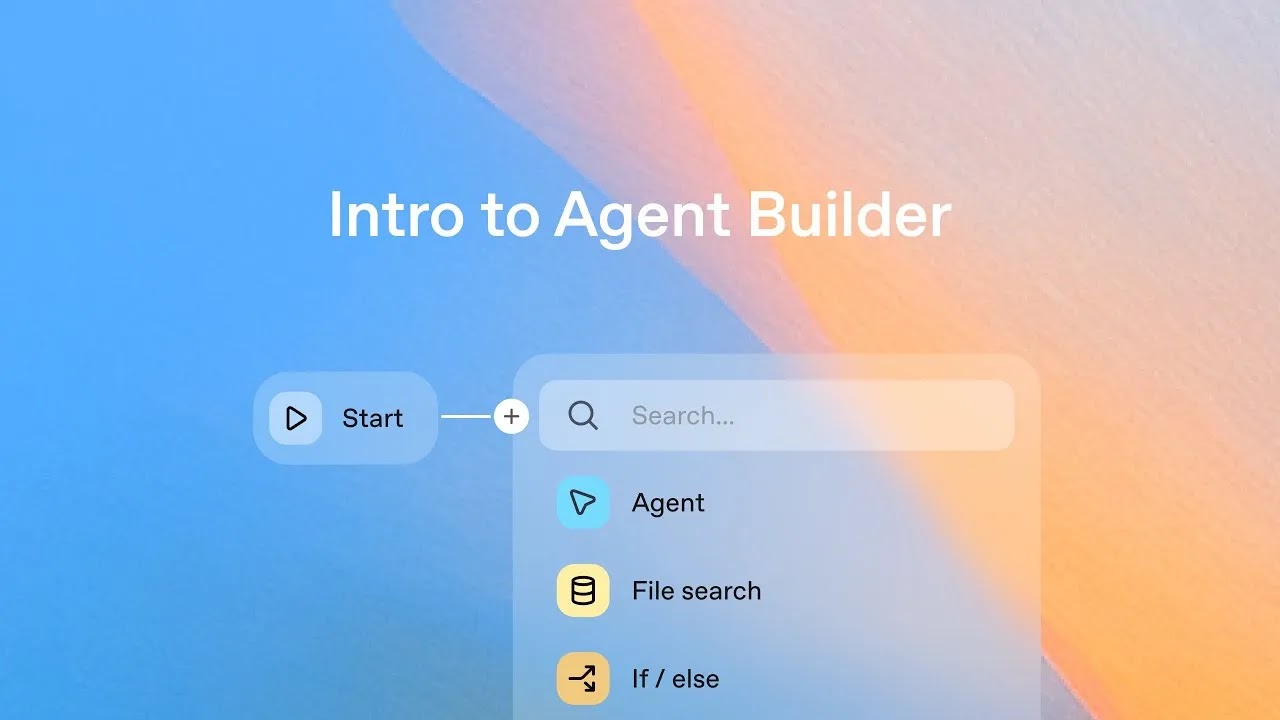
OpenAI’s new Agent Builder empowers developers to design, test, and deploy AI agents without writing complex orchestration code. The tool introduces a visual, drag-and-drop environment where creators define how agents behave, connect tools, and manage conversations.
This platform changes the old development process. Instead of writing layers of logic or managing APIs manually, developers now use a visual canvas that makes the entire workflow transparent and easy to modify. OpenAI aims to make agent creation faster, more intuitive, and accessible to both technical and non-technical teams.
Inside the System: Core Components and Design
The Visual Canvas
The heart of Agent Builder lies in its canvas. Developers drag and connect nodes that represent steps in an agent’s reasoning process. Each node can handle actions like retrieving data, running logic branches, or invoking external tools.
This structure helps teams visualize workflows. The node connections show how decisions unfold, how data flows between components, and where fallback paths handle exceptions. The design promotes clarity and reduces the risk of hidden errors in the logic.
Tool Integration and Connectors
Agent Builder comes with built-in tools that allow agents to perform tasks like searching data, analyzing documents, or interacting with online services. Developers can extend these capabilities through connectors integrations that link external platforms, databases, or APIs directly into an agent’s workflow.
These connectors simplify automation. Instead of writing custom scripts for every data source, a developer can drag the appropriate connector into the canvas and configure it visually.
Developer SDK and Responses API
OpenAI complements the visual tool with a Developer SDK for Python and Node.js. This SDK provides programmatic control for teams that prefer to define agents through code.
The Responses API bridges simple chat interactions and full agent behavior. It allows messages to trigger tool usage and structured reasoning, so agents can both respond conversationally and take real actions.
Evaluation, Monitoring, and Safety
OpenaAI Agent Builder includes tools for evaluation and observability. Developers can trace each action the agent performs, test decision paths, and measure performance. Built-in safety controls prevent exposure of sensitive data and reduce the risk of unintended or harmful actions.
By integrating these safety and monitoring features directly into the design flow, OpenAI encourages responsible deployment and easier debugging of complex agents.
Building with Purpose: What You Can Create
Customer Support Agents
Teams can design support assistants that answer questions, pull data from knowledge bases, and escalate difficult cases to human staff. The visual logic helps model conversation flows and fallback responses clearly.
Developers can build agents that process documents, extract data, and route information between systems. With the right connectors, an agent can transform tedious manual workflows into fully automated operations.
Research and Data Analysis
Agents can gather data, summarize results, and generate structured reports. The combination of reasoning nodes and tool connectors enables deep automation for analytics pipelines.
OpenAI Agent Builder integrates with OpenAI’s chat components, so developers can embed interactive agents directly into websites or applications. This approach allows teams to deliver intelligent features to users without heavy backend setup.
Developers can connect several agents that work together. One agent might collect data, another might analyze it, and a third might present results. The canvas supports these multi-agent systems through linked workflows and shared context.
The Future of Agent Development
OpenAI Agent Builder signals a shift toward accessible agent creation. OpenAI’s approach combines simplicity with depth: a no-code visual environment backed by a developer-grade SDK.
In the future, we can expect more pre-built templates, stronger enterprise governance features, and broader support for multimodal inputs such as images, audio, and video. As organizations adopt this workflow, they will shorten development cycles and reduce the gap between concept and execution.
Agent Builder stands as a milestone in AI tooling—one that transforms the process of building intelligent systems into a clear, visual, and collaborative experience.
Deja un comentario